On 19 April 2026 we celebrated the 225th birthday of the polymath and founding director of the Leipzig Physics Institute, Gustav Theodor Fechner.
We started the tour in the Neues Augusteum and the University Chapel Paulinerkirche with an introduction into the history of Leipzig University. On our path through the Graphisches Viertel to the Fechner Villa we discussed the rise of the publishing industry in the 19. century, and its impact on the educational institutions in Leipzig. In front of the villa, where Fechner was living for most of his life, we revisited his eventful life. Subsequently, on the way through the Johannisfriedhof and the Talstraße we learned more about his friends and contemporaries in Leipzig. The tour was concluded in the Talstraße in the ensemble of buildings erected for the first scientific institutes of the university.
.](https://leipziger-wissensspuren.de/blog/2026-04-19_fechner/2026-04-19_tour-map-Fechner.png)
Itinerary of our Tour. The encircled letters refer to positions mentioned in the text. Generated with bikerouter.de.
The first 400 years of Leipzig University
The Paulinerkirche served as University Church from the foundation of the university till 1968, when it was blasted by a decision of East German state, city and university officials. This demolition met fierce, but futile opposition by the civil society and members of the university, who tried to evacuate as much of its historic artistic treasures as possible. After the reunification, a modern building, the Paulinum 🇦 was erected at the historic location that alludes to the historic site. Since 2009 it serves as the assembly hall of the university and as church for University Services. The preserved monuments of the Paulinerkirche are renovated and restored to the chapel. At this historic site we contemplated the blend of historic traditions and adoption of modern trends that form the core of a thriving university.
The Alma Mater Lipsiensis was founded in 1409 by an initiative of scholars who emigrated from Prague as a reaction of the Decree of Kuttenberg that shifted the power in the steering board of the Charles University of Prague towards the Bohemian nation. Leipzig University adopted a constitution where students and faculty lived in colleges (e.g. the Rotes Kolleg in the Ritterstraße at the Nikolaikirchhof). In addition they were organized into four student nations: Natio Misnensium (native region of present Saxony), Saxonum (Northern Germany and Northern Europe), Bavarorum (Southern Germany, Southern and Western Europe), and Polonorum (Silesia, Eastern Germany and Europe). The cosmopolitan spirit of the university at those times is reflected in the election regulations (cf. this German page) that aimed to provide equal political power to university members of the four nations.
, [CC BY-SA 3.0 DE](https://creativecommons.org/licenses/by-sa/3.0/de/deed.en), via [Wikimedia Commons](https://commons.wikimedia.org/wiki/File:Fotothek_df_roe-neg_0000284_002_Augustusplatz_mit_Paulinerkirche.jpg). Other Photos: Team WissensSpuren.](https://leipziger-wissensspuren.de/blog/2026-04-19_fechner/02_Augustusplatz.jpeg)
Photos taken in the Neues Augusteum, University Church St. Paul (top row, 🇦) and on the Augustusplatz (bottom center and right, 🇧), and a [photo of the Paulinerkirche taken in 1948. Historic Photo: Deutsche Fotothek, CC BY-SA 3.0 DE, via Wikimedia Commons. Other Photos: Team WissensSpuren.

In its first 400 years the teaching of the university involved a studium universale of the seven liberal arts. It started off with the trivium of rhetoric, grammar, and dialectic (logic) — rounded out by studies of the quadrivium of astronomy, arithmetic, geometry, and music. This education was delivered by the Faculty of Philosophy. After this basic education the students were admitted to the courses in the Faculty of Theology, Faculty of Law, and Faculty of Medicine. This traditional system of organizing residence, education, and political offices at the university was maintained till 1830. Subsequently, the transition the modern setup of the University started where the administration and teaching is based on Faculties and Research Institutes.
On our way across the Augustusplatz 🇧 we looked back to digest how the structure of the medieval church St. Paul has evolved into the modern architecture of the Paulinum.
Subsequently, we proceeded through the Graphical Quarter 🇨-🇩-🇪 and had a look into the rise of a class of industrialists and publishers in Leipzig that shared a great appreciation for education. In 1768 Aleksander Józef Jabłonowski moved to Leipzig to set up the Societas Jablonoviana, that took a decisive role in founding the Saxon Academy of Sciences and Humanities in Leipzig. The Brockhaus family sponsored the Steyberschen Erziehungsinstituts (Educational Institute) for “daughters of wealthy parents” that became a nucleus for the implementation of higher female education in Germany. The Reclam and Meyer (cf. Bibliographisches Institut publishing houses specialized in producing inexpensive editions of classical scientific literature for broad audiences. Many patrician and noble families set up funds to sponsor educational and research projects.
Fechner was a member of the Societas Jablonoviana, involved in the erection of the Academy, made major contributions to the encyclopedia and almanacs published by Meyer and his successors, translated chemical works from French, and he was the editor of scientific and literary journals.
Fechner’s life
In 1850 Fechner took residence in the Villa Fechner 🇫, and he lived there till his death in 1858. Right next to his home was the publishing house of Johann Conrad Hinrichs. At this historic place Elmar Schenkel provided an overview of Fechner’s life and his literary achievements.
In 1818 Fechner enrolled at Leipzig University.
In 1819 he earned his B.Sc. degree,
in 1823 he became a lecturer at the university,
in 1834 a full professor, and
in 1835 the founding director of the Physics Institute.
As a professor he was running experiments, teaching at the university, and publishing at a mind-blowing pace: on average his oeuvre was growing by five pages every day!
However, in 1839 he had to resign due to blindness afflicted while doing optical experiments with bright light. This sickness also infested his mental well-being. At some point he stops communicating with his environment and does not accept food any longer. Rescue comes from a remote acquaintance who dreamed about a diet that is indeed initiating his recovery.
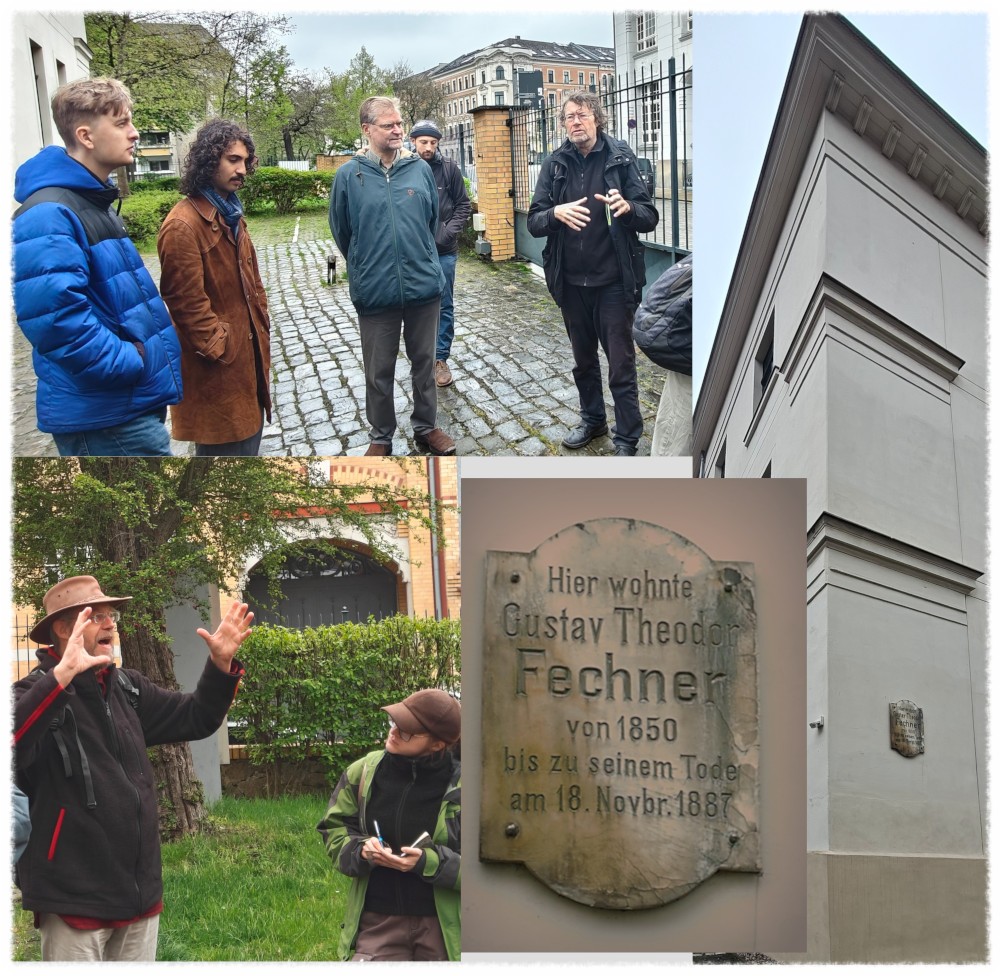
Discussion about Fechner’s life at the Villa Fechner 🇫. Photos: Team WissensSpuren.
Fechner experiences the regaining his vision and the subsequent steps into his garden as a life-changing experience:
I still remember well the impression it made on me when, after my multi-year eye illness, I stepped out from my darkened room for the first time into the blooming garden without a bandage over my eyes. […] The whole garden stood transfigured, as if it were not I but nature that had arisen anew. And I thought to myself: All it takes is to open one’s eyes anew for nature, once old, to be made young again. Indeed, one could hardly believe how fresh and lively nature strikes those who confront it with fresh eyes.
— from Gustav Theodor Fechner: Nanna (“Noch Einige Gedanken”). 4th ed. With an introduction by Kurd Lasswitz. L. Voss, 1908.
— translated by Rachael Petersen, in Gustav Fechner and the Vision of the Plant-Soul.
Once recovered, in 1843, he is appointed Professor for Natural Philosophy and Anthropology at Leipzig University, and he resumes his membership in the Societas Jablonoviana. The main difference in his working habits will be that he is publishing over a still larger range of topics, and that he is adopting a holistic world view that strives to establish connections between apparently unrelated fields — in a spirit that truly deserves the modern label of a systems-theory approach. He is willing to seriously consider even the wildest hypothesis, under the pseudonym Dr. Mises he explores them as a creative writer, and as a researches he subjects them to brutishly crisp scientific and statistical analysis.
Thus, his inquisitive mind provides impetus for establishing research directions in the faculties and in new research institutes of the university. In particular, he paves the road to establishing the Institute of Psychology at Leipzig University.
More about his friends and contemporaries
Just a few steps away from the Villa Fechner was the home of Clara and Robert Schumann during their first years of marriage, 1840–44. Fechner certainly knew Clara Schumann since his sister had become the second wife of Clara Schumann’s father Friedrich Wieck, when Clara was nine years old.
Moreover, in the winter 1865/66 Friedrich Nietzsche lived in the building next door, Scherlstrasse 4 (at that time Blumengasse). In this winter Nietzsche comes to know the philosophy of Schopenhauer, that will lead him to become a pioneer of the Lebensphilosophie. In close agreement with Fechner he adopted an approaches to science and philosophy that rejected a mechanistic and materialist focus. Still it is not knows if Fechner and Nietzsche ever discussed their views. A significant obstacle in such a dispute might have been their relation to mathematics, an important scientific and philosophical tool for Fechner and subject of little interest to Nietzsche.
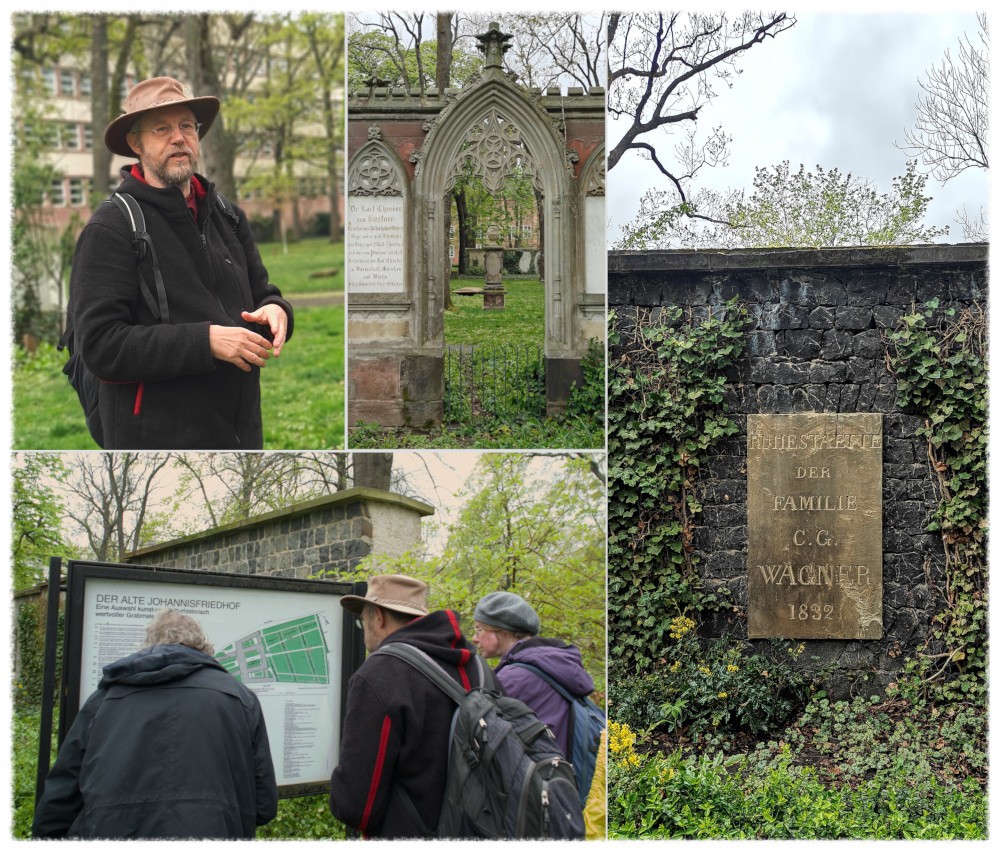
Looking for graves at the Johannisfriedhof 🇬-🇭. Photos: Team WissensSpuren.
We crossed the Johannisfriedhof 🇬-🇭 on our subsequent way towards the Academic Quarter. On the graveyard we looked for the grave of the Wagner family, and discussed the the relation of Richard Wagner and Nietzsche who came to know each other in Leipzig in 1868.
 🇯. Photos: Team WissensSpuren.](https://leipziger-wissensspuren.de/blog/2026-04-19_fechner/09_Ogai_Peters.jpeg)
Crossing the Prager Straße and taking note of the commemorative plaque in honor of Mori Ōgai 🇮 and the building of the C.F. Peters music publishing house, which is presently home of the Grieg meeting place 🇯. Photos: Team WissensSpuren.
In 1881 at the age of nineteen Mori Ōgai obtained his medical degree from the University of Tokyo Faculty of Medicine. Subsequently, he became a medical officer in the Japanese army. In this function he was sent to Germany to complement his education in medicine. In Leipzig took residence in a house 🇮 at the corner of Prager Straße and Talstraße. At the plaques, that commemorates his stay in Leipzig, Elmar Schenkel reported his achievements. During his four-year stay in Germany Ōgai did not only study military tactics and medicine, but he also took a deep interest in literature and culture. This was a formative period of his life,
Now that I return to the East, I feel a very different person from when I set out to travel across the ocean to the West.
— Mori Ōgai, quoted from Humboldt-University Ogai portal
Back in Japan Ōgai teaches at the Army Medical College, and eventually becomes its director. In this institution he modernizes the curriculum, and he contributes to the public debates addressing the Japanese transition to modernity. In 1907 he was appointed surgeon general, and the head of the Army Ministry’s medical division. At the same time he contributes translations to make Western literature available to the Japanese audience, and he becomes one of the creators of modern Japanese literature.
His biography is a prime example of the international allure of Leipzig as a center of education in the 19th century, which is also expressed in the overwhelming prize of the city in
When it comes to the most noble and dignified of all endeavors — the promotion of humanity — no other place in the world can compare to Leipzig.
— entry for Leipzig in Meyer’s Universum (1837)
translated by DeepL.com.
On the way to the historic science campus we stopped another time to acknowledge the role of Henri Hinrichsen 🇯 as a patron of educations institutions and collections, in particular providing the funds to set up Henriette Goldschmidt’s college for women and bring the collection of Musical Instruments of to the Leipzig University.
Science and science buildings in the Talstraße
Gustav Fechner and his successor, Wilhelm Eduard Weber, still did their physics research in the physical cabinet in the Augusteum. In 1873 the physics institute finally got his own building 🇰 in the Talstraße 35. By this time its research comprised work in experimental physics (Wilhelm Gottlieb Hankel), theoretical and mathematical physics (Carl Neumann), physical chemistry (Gustav Heinrich Wiedemann), and mineralogy and geology (Ferdinant Zirkel). Fechner augmented this work by pioneering the fields of experimental physiology (Weber–Fechner law) and psychology (sensation, Fechner paradox, consciousness).
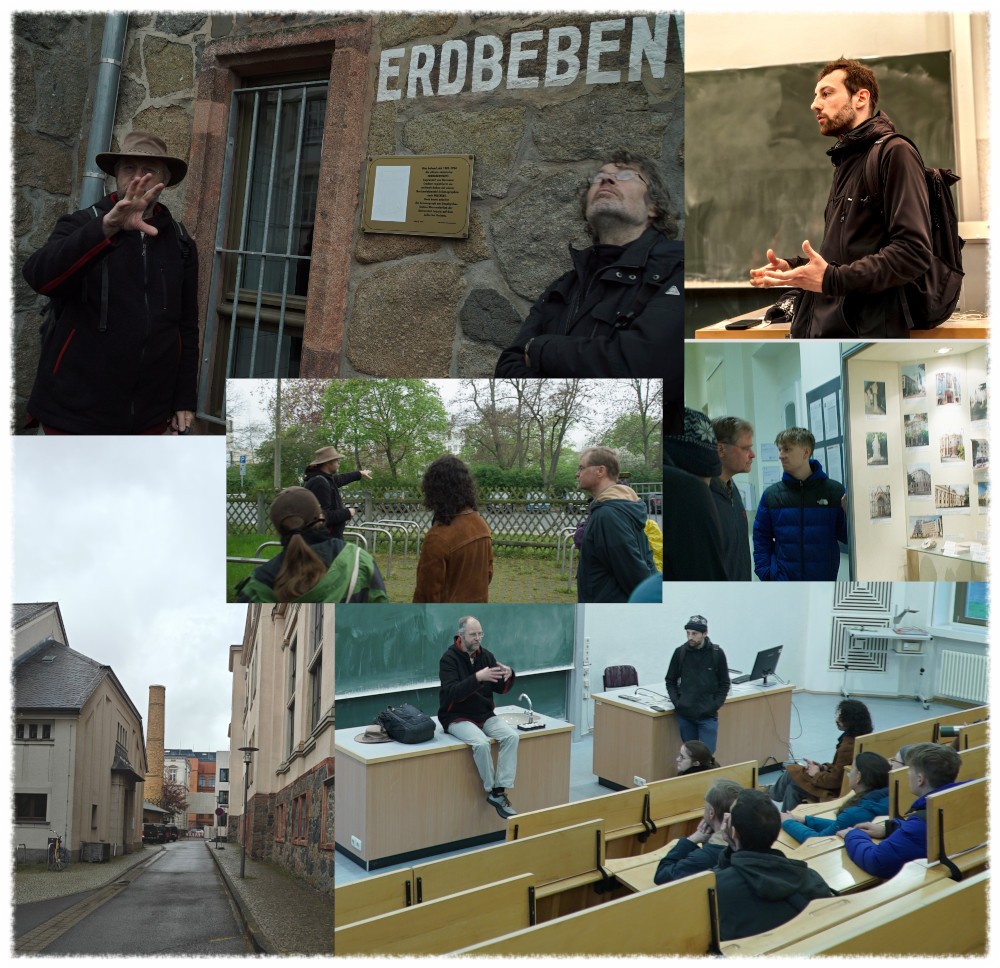
Visiting the first physics building of the university 🇰 in the Talstraße 35. Photos: Team WissensSpuren.
Fechner’s broad range of research interests and the excellent financial situation of the university provided an environment that spawned the foundation of a plethora of research institutes at the university. Following up on these divisions, the tight connection between disciplines was softened, and the main stream of research in the natural sciences adopted a materialistic and reductionistic views of the world. In contrast Fechner’s philosophical ideas incorporate Science and Soul into a holistic description of the world. They are at odds with strong materialistic traditions that emerged and grew strong during his life. Hence, his work went into a Sleeping Beauty’s slumber for a hundred years.
Presently, they are appreciated again by plant neurobiologists exploring sensation, memory, and intelligence beyond the animal model — and by scholars who advocate nature rights as a guiding principle for a sustainable development of humanity on a global scale. In this context, a thesis on Fechner’s treatise “Nanna, or The Inner Life of Plants” by Rachel Petersen has recently been awarded the Esther Sellholm Walz Prize of Harvard University.
We are immensely grateful to Elmar Schenkel (Leipzig University) for joining the tour and generously sharing his vast knowledge about Gustav Fechner and his contemporaries in Leipzig. We warmly recommend to take a look into his book Die elektrische Himmelsleiter that comprises a short biography of Gustav Fechner.