
235 years ago, author and political activist Olympe de Gouges published the Déclaration des droits de la Femme et de la Citoyenne (Declaration of the Rights of Women and Citizens), and it took almost 200 years for them to be implemented in Western Europe. On the International Women’s Day, we traced the long road to their adoption, and took note of the important contributions made by women in Leipzig — with notable interludes to discussion where we stand today.
We started the tour in the INSPIRATA with an introduction, and a guided tour addressing female scientists who were not accredited for their achievements.
.](https://leipziger-wissensspuren.de/blog/2026-03-08_female-rights/2026-03-08__Route_taken.png)
Itinerary of our Tour. Generated with bikerouter.de.
On the first leg of our walk (A-D on the map) we looked into mechanisms in our societies that contribute to social exclusion and to the reproduction of poverty.
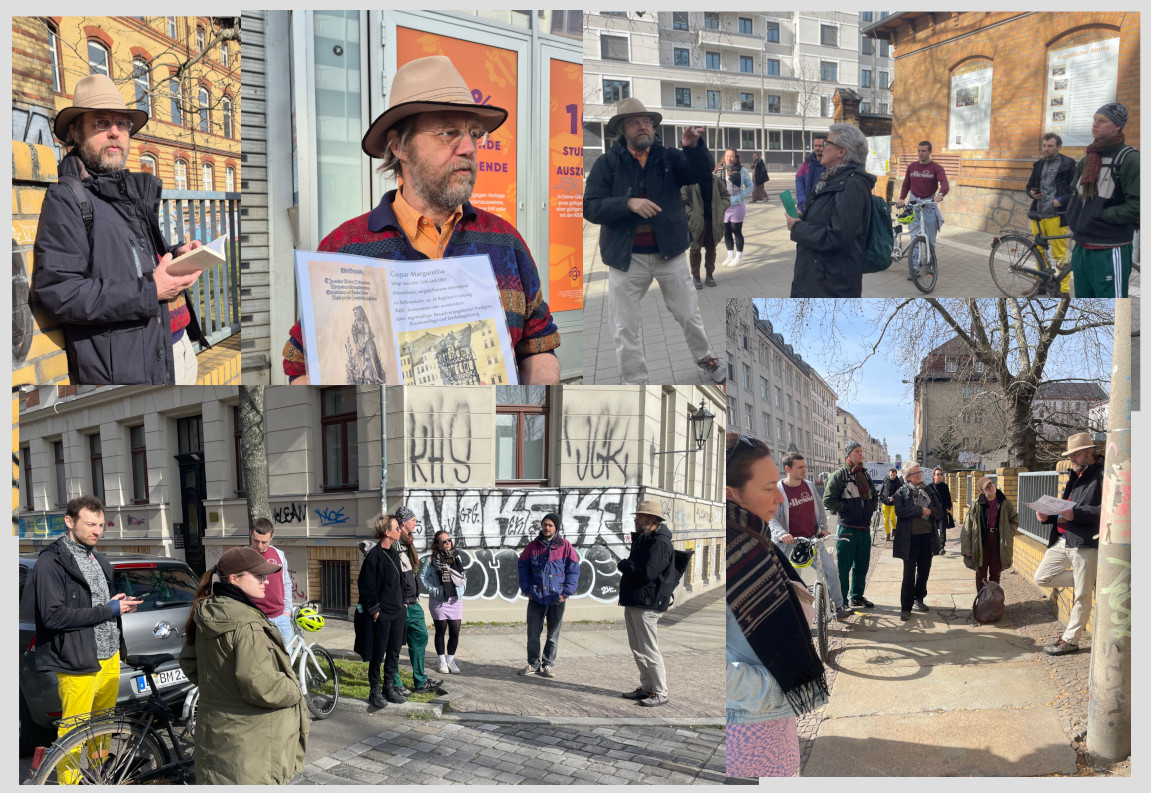
Photos: Team WissensSpuren.
The second leg addressed the astounding efforts of three pioneers of the feminist movement: Louise Otto-Peters, Henriette Goldschmidt and Auguste Schmidt. In a joint effort with the activists of the socialist movement they set up facilities for the education of women of all classes, and encouraged and supported them to even pick up university studies. One of their very successful students, Clara Zetkin, became a leader of the international feminist movement, and initiated the International Women’s Day.
, and photos from the tour.](https://leipziger-wissensspuren.de/blog/2026-03-08_female-rights/04_frauenbewegung.jpg)
Portraits of the main figures of the early feminist movement in Germany from Die Gartenlaube (1883), and photos from the tour. Photos: Team WissensSpuren.

Upon our arrival in the city center, we walked by the Women’s Day Demonstrations, and then stopped for our final waypoint: We sneaked into the rear courtyard of House of the Three Saint Kings where August Bebel set up his factory for door and window handles from buffalo horn, and where his family lived int he first floor. At this historic site we acknowledged the role of his wife in supporting his career as a politician, and as a supervisor of the factory while he was imprisoned. Finally, we recited his greeting address in Leipzig on occasion of the 1st International Women’s Day on the 19th of March 1911.
We would like to express our sincere thanks to Juliane Rudolph for her splendid introduction into the unrecognized discoveries of female scientist — and to the participants for their lively interest and intensive exchange.
A more detailed retrospection is available on our German page.