
Our walk addressed the benefits of diversity, and the challenges of dealing with diversity.
iDiv. Understanding BioDiversity
A tour of the iDiv gave us insights into current research topics and issues being addressed at the German Centre for Integrative Biodiversity Research–iDiv in Leipzig. A particular focus was placed on the special significance of the diversity of organisms in our soils, which is almost invisible to us and still so important for fertility and hydrology.
We would like to express our sincere thanks to Zarah Janda for the tour of the institute, the insights into her work, and the discussions about the activities at the research institute.
. Photos: Team WissensSpuren.](https://leipziger-wissensspuren.de/blog/2026-02-07_diversity/iDiv_Bio.jpg)
Insights into the research at iDiv. Photos: Team WissensSpuren.
During the short walk from the iDiv to the INSPIRATA, we discussed ecosystem services: Is biodiversity a value in itself, in the sense of a non-negotiable fundamental right, or should it be assigned a monetary value from an economic perspective — thereby creating a systematic approach to the possibility of compensation payments for interventions in ecosystems?
INSPIRATA. Prominent Mathematicians with prominent handicaps
In the INSPIRATA., we discussed the challenges of integrating people with special mental or physical challenges. The starting point of this discussion was a depressing historical testimony expressed in the poem “Das Hexenkind” (The Witch Child) by Joachim Ringelnatz, in [Kinder-Verwirr-Buch] (https://commons.wikimedia.org/wiki/File:Kinder-Verwirr-Buch_07.jpg) from 1931:
The Witch Child
The young thing was called Ilse Watt.
She was raised in an orphanage.
Where she was considered stubborn, deceitful,
Because she never spoke a word
And since people strongly her resented
That early in the morning, when she woke,
She would quietly laugh to herself.
Because her behavior was so strange,
she was called the witch child.
She was scolded everywhere she went.
But no one dared to hit her.
For she had been blind since birth.
Ilse was considered cheeky
because when she was put to bed,
She still laughed quietly to herself.
Pale and weak in her little bed,
one day lay dying, the sick
and silent, blind Ilse Watt
Smiling as if from another world,
And said to an employee
Who stroked her hair,
Loudly and happily, “Thank you.”
We traced the life stories of three important mathematicians of the last century who achieved inclusion to a certain extent:
- [Alan Turing](https://royalsocietypublishing.org/rsbm/article/doi/10.1098/rsbm. 1955.0019/88236/Alan-Mathison-Turing-1912-1954) made essential contributions during World War II to breaking German encryption machines and subsequently to the development of computing machines and molecular biology. On the other hand, he was convicted of homosexual acts, and there are strong indications that he had Asperger syndrome.
- Kurt Gödel made groundbreaking contributions to mathematical logic. On the other hand, he also suffered from Asperger syndrome and in the course of his life he contracted an extreme paranoia.
- At the age of 20, [Stephen Hawking](https://royalsocietypublishing.org/rsbm/article/doi/10.1098/rsbm.2019. 0001/116037/Stephen-William-Hawking-CH-CBE-8-January-1942-14) was diagnosed with amyotrophic lateral sclerosis (ALS), and by the age of 40 he was almost completely paralyzed. Nevertheless, he lived to the age of 76, and he made groundbreaking contributions to science until well into his old age.
, via [Wikimedia Commons](https://commons.wikimedia.org/wiki/File:Schritte_zur_Inklusion.svg) [text shortened and with larger font size]; Alan Turing in Copeland: [The Essential Turing](https://archive.org/details/turing_202010/page/n1/mode/2up); Kurt Gödel in [Encyclopædia Britannica](https://www.britannica.com/biography/Kurt-Godel); Stephen Hawking via [OpenClipart](https://freesvg.org/stephen-hawking-scientist); drawing of Joachim Ringelnatz in [„Kinder-Verwirr-Buch“](https://commons.wikimedia.org/wiki/File:Kinder-Verwirr-Buch_07.jpg).](https://leipziger-wissensspuren.de/blog/2026-02-07_diversity/inspirata-inklusion.jpg)
Chances and challenges of inclusive education based on the biographies of three eminent mathematicians. Sources from left to right: Steps on the path of inclusion by Robert Aehnelt, CC BY-SA 3.0, via Wikimedia Commons [text shortened and with larger font size]; Alan Turing in Copeland: The Essential Turing; Kurt Gödel in Encyclopædia Britannica; Stephen Hawking via OpenClipart; drawing of Ringelnatz in „Kinder-Verwirr-Buch“.

On the way across Deutscher Platz to the National Library, we discussed teachers’ expectations of their students. Allegedly, teachers have been complaining for 5000 years that students are getting dumber and dumber.
DBSM. Developments of written communications
Our sources for the exchange of teachers and students in ancient times are Sumerian clay tablets with exercises by students, comments noted on the tablets, and some entries in clay tablet diaries. Gustav Keller, for example, provides details on the school situation at that time and its development into the modern era in his booklet Die Schülerschelte — Leidensgeschichte einer Generation (The Scolding of Students — The Suffering of a Generation). The scientific work of the scribes and their astonishing skills in mathematics are evidenced by many finds of clay tablets with astronomical records.
At the German Museum of Books and Writing we traced the evolution of writing from cuneiform script to our modern diversity of fonts. There is a font with just the right serifs and the right width and thickness for pretty much every occasion and purpose.
: From cuneiform script (left), via classical and modern fonts (center) to cartoons (right). Photos: Team WissensSpuren.](https://leipziger-wissensspuren.de/blog/2026-02-07_diversity/DNB_communication.jpg)
Different forms of communication and of preserving cultural goods are as documented in the collections of the DNB: From cuneiform script (left), via classical and modern fonts (center) to cartoons (right). Photos: Team WissensSpuren.
In addition to writings and books, the DNB also collects cartoons. A particular highlight is the collection of Armin Abmeier, acquired in 2021, which contains a comprehensive collection of groundbreaking cartoons in which Robert Crumb has documented his life and surroundings during the past 60 years.
University. Cultural Diversity and Sustainability
The our ended with a visit of a poster exhibition on Leipzig research projects related to the United Nations Sustainable Development Goals. They were prepared as final project of the 5th lecture series Action Competence for Sustainable Development, where the participants reflected the multiple connections between the lectures in the series. Each winter semester, the lecture series serves as a learning laboratory for diversity at the university: students from many different countries and from a wide range of degree programs offered by the university meet once a week to exchange ideas with a scientist and learn about his or her research. Over the course of the semester, this results in a panorama of different perspectives and research approaches related to sustainability.
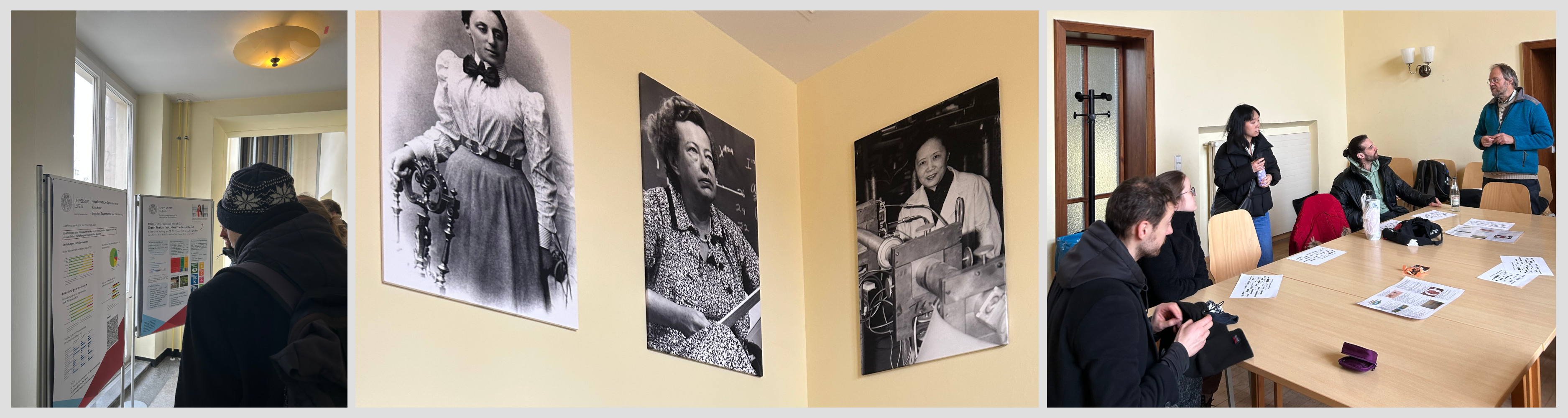
Research and teaching on sustainable development at Leipzig University. Photos: Team WissensSpuren.
The tour concluded with a discussion round on our experiences with diversity: Where have we benefited from diversity in our lives? Where do we see developments for the worse and for the better? What are the downsides of current concepts of sustainability, and what needs to be considered in the future?
We are immensely grateful to the participants for sharing their experiences and ideas, and for the intensive exchange of ideas.